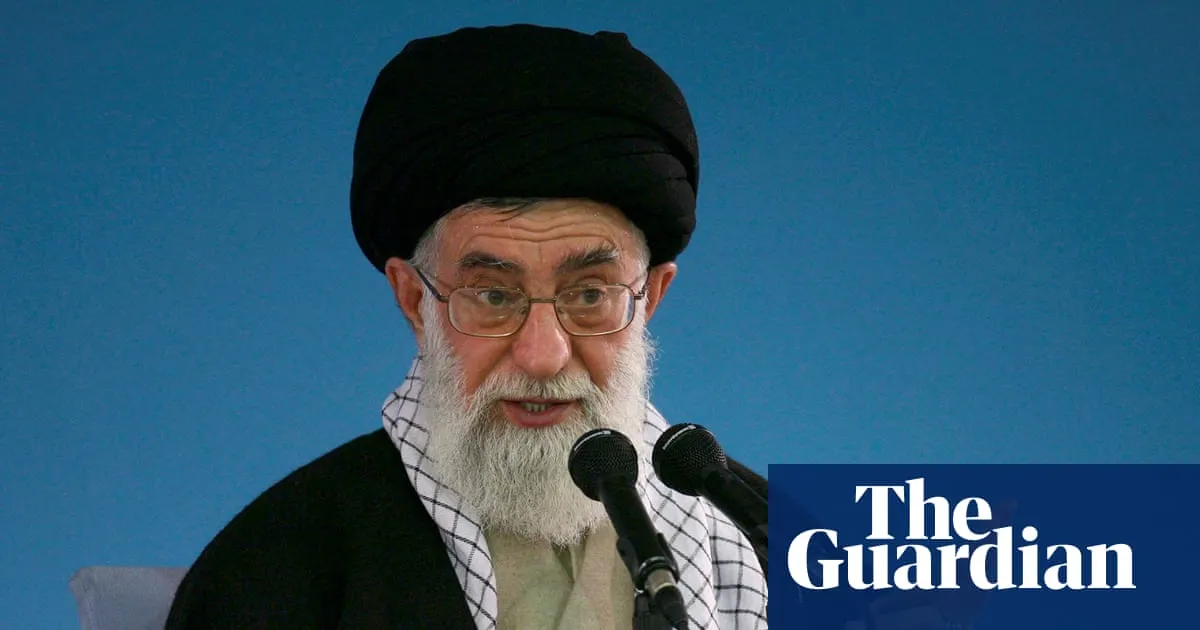
Iran’s Supreme Leader Ayatollah Khamenei Killed in US-Israeli Attack
Iran’s supreme leader, Ayatollah Ali Khamenei, has been confirmed dead following an airstrike conducted by Israel and the United States. He was 86 years old.
Iranian state media reported the news early Sunday, shortly after US President Donald Trump announced that Khamenei had been killed in a coordinated US-Israeli airstrike targeting his compound on Saturday.
“It is announced to the Iranian people that His Eminence Grand Ayatollah Imam Sayyid Ali Khamenei, Leader of the Islamic Revolution, was martyred in the joint attack launched by America and the Zionist regime on the morning of Saturday, February 28,” stated Iran’s semi-official Tasnim News Agency. Reports indicate that Khamenei’s family members, including his daughter, son-in-law, and grandson, also perished in the attack.
Trump claimed that Khamenei and other Iranian officials “couldn’t escape US intelligence and the advanced tracking systems.”
Khamenei’s Rise to Power
Khamenei ascended to the position of supreme leader in 1989, following the death of Ayatollah Ruhollah Khomeini, the influential figure behind the Islamic Revolution a decade earlier.
While Khomeini was the ideological leader of the revolution that dismantled the Pahlavi monarchy, Khamenei was instrumental in developing the military and paramilitary structures that fortified Iran’s defense and extended its influence beyond its borders.
Before his tenure as supreme leader, Khamenei served as president during the Iran-Iraq War in the 1980s. This protracted conflict, alongside a sense of isolation as Western nations supported Iraqi leader Saddam Hussein, fostered Khamenei’s deep-seated distrust of the West, particularly the United States, according to analysts.
Defensive Posture and Military Expansion
This sentiment shaped Khamenei’s long-standing rule, reinforcing the notion that Iran must perpetually defend itself against both external and internal threats.
“People perceive Iran as a theocracy due to Khamenei’s clerical attire and the religious language of the state, but he was a wartime president who emerged from conflict with the belief that Iran is vulnerable and requires security,” noted Vali Nasr, an expert on Iranian affairs. “The US is hostile to Iran; thus, the revolution, the Islamic Republic, and nationalism must be safeguarded.”
Under Khamenei’s leadership, the Islamic Revolutionary Guard Corps (IRGC) transformed from a paramilitary entity into a dominant security, political, and economic institution, pivotal to Iran’s regional influence. Khamenei also advocated for a “resistance economy” to promote self-sufficiency amid stringent Western sanctions, while he maintained a strong skepticism towards engagement with the West.
Challenges to Khamenei’s Rule
Throughout his rule, Khamenei faced significant challenges, including the 2009 protests against a disputed presidential election and the 2022 demonstrations regarding women’s rights.
The most substantial threat emerged in January 2026, when protests sparked by economic distress escalated into widespread calls for the overthrow of the Islamic Republic. The government’s response led to one of the most violent confrontations since the 1979 revolution.
Critics accused Khamenei of being disconnected from a younger populace that sought reforms and economic improvement over isolationism and ongoing conflicts with the US and Israel.
Early Life and Education
Khamenei was born in 1939 in Mashhad, a significant Shia city in northeastern Iran. He was the son of a prominent Muslim leader and an ethnic Azerbaijani from Iraq. The family initially settled in Tabriz before moving to Mashhad, where Khamenei’s father led a mosque.
His mother, Khadijeh Mirdamadi, was an avid reader who nurtured Khamenei’s love for literature and poetry, supporting his involvement in the anti-Pahlavi movement.
Khamenei began his education at age four, learning the Quran, and later attended theological schools, studying under notable Islamic scholars, including Khomeini, in Qom.
Political Career and Leadership
After the monarchy was overthrown, Khamenei became a key figure in establishing the new Iran, briefly serving as defense minister in 1980 and later overseeing the IRGC during the Iran-Iraq War. In 1981, he survived an assassination attempt, which resulted in the loss of his right arm, and subsequently became Iran’s first clerical president.
Following Khomeini’s death in 1989, Khamenei was appointed supreme leader by a council that revised the constitution to relax the qualifications for the position. Khamenei’s leadership was marked by efforts to rebuild a nation devastated by war, with over a million casualties and a shattered economy.
Consolidation of Power
Throughout the 1990s, Khamenei faced a changing political landscape as the revolutionary fervor waned and calls for reform grew. The election of reformist Mohammad Khatami in 1997 signaled a desire for improved relations with the West, but Khamenei viewed this as a threat to the established order.
To counter reformist movements, Khamenei invested in the education and training of younger generations within the IRGC, ensuring a loyal base that would support his vision of perpetual resistance against the West.
During the 2009 Green Movement protests, Khamenei’s endorsement of the election results and subsequent crackdown on dissent marked a significant moment in his leadership, as thousands were arrested and dozens killed.
Negotiations and International Relations
Khamenei’s pragmatism was evident in 2015 when he approved negotiations that led to the Joint Comprehensive Plan of Action (JCPOA), aimed at curbing Iran’s nuclear program in exchange for sanctions relief. However, following President Trump’s withdrawal from the agreement in 2018, Khamenei reverted to a more aggressive stance, ruling out negotiations with the US.
As protests erupted in 2019 over rising fuel prices, Khamenei dismissed demonstrators as “thugs,” and the government’s violent response resulted in significant casualties.
In 2022, protests ignited following the death of Mahsa Amini in police custody, leading to widespread unrest and a brutal crackdown that left hundreds dead.
Legacy and Conclusion
Khamenei’s legacy is marked by his efforts to maintain Iran’s independence and power, both domestically and regionally. His strategic alliances with groups like Hezbollah and Hamas, as well as his role in the “axis of resistance,” shaped Iran’s foreign policy.
However, his leadership faced increasing challenges, culminating in the recent protests and unrest that questioned the legitimacy of his regime. As Iran navigates a complex political landscape, Khamenei’s death marks a significant turning point for the nation.