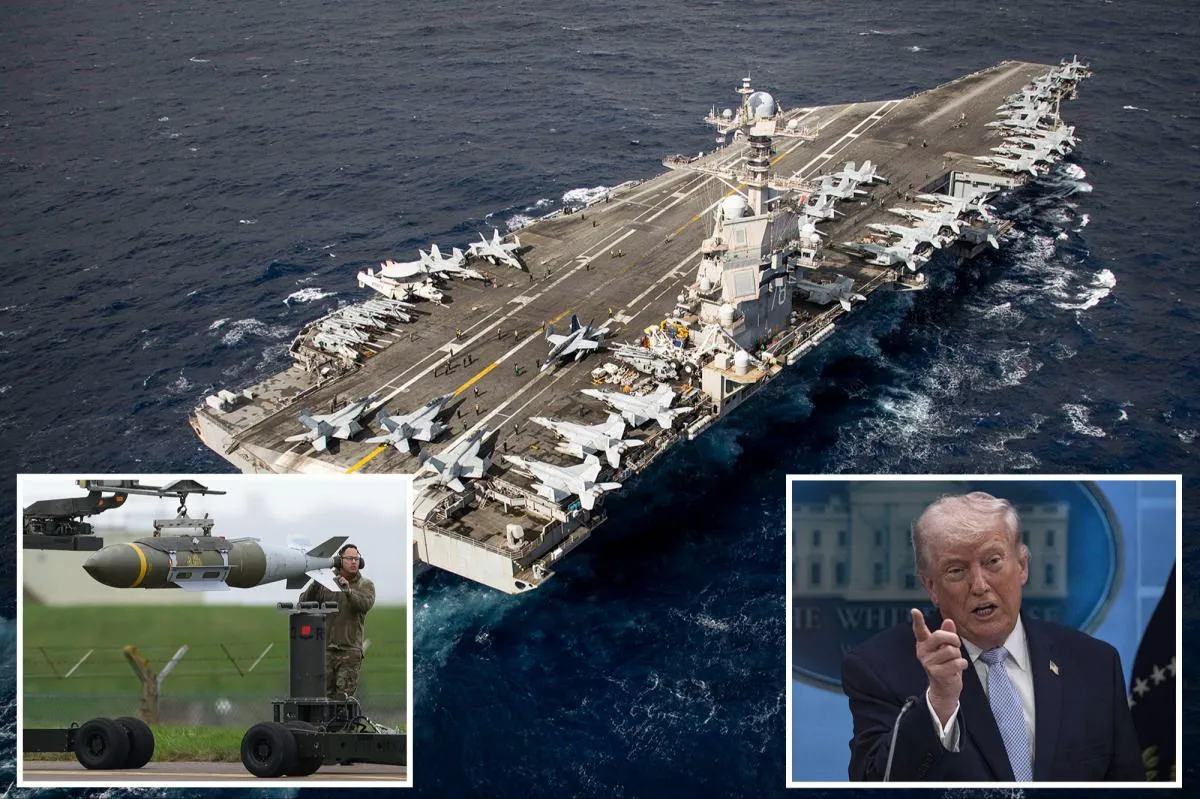
“We’re loading up the ships with the best weapons ever made, even at a higher level than we used to do a complete decimation,” declared President Trump, underscoring the urgency of the situation as peace talks between the United States and Iran begin in Pakistan.
Negotiations commenced following a two-week ceasefire that was reached on April 7, 2026, amidst a war that has claimed over 5,000 lives across Iran and Lebanon. The US delegation, led by Vice President JD Vance, special envoy Steve Witkoff, and Jared Kushner, is engaged in face-to-face discussions with Iranian representatives, headed by Parliament Speaker Mohammad Bagher Ghalibaf.
The backdrop of these talks is grim; the ongoing conflict has severely disrupted the Persian Gulf, sending energy prices soaring and causing significant damage to infrastructure in several Middle Eastern nations. The war has resulted in at least 3,000 fatalities in Iran and 2,020 in Lebanon, with the recent violence in Beirut claiming 300 lives on April 7 alone.
As the negotiations unfold, President Trump has made it clear that the US is prepared for military action should the talks fail. “Let’s see what happens — maybe they make a deal, maybe they don’t. It doesn’t matter. From the standpoint of America, we win,” he stated, emphasizing the US’s readiness to escalate military operations if necessary.
Key issues on the negotiation table include sanctions, the status of the Strait of Hormuz, and Iran’s nuclear enrichment program. The US has demanded that Iran surrender an estimated 1,000 pounds of enriched uranium and fully reopen the strategic waterway, which is vital for global oil transport.
Iran, on the other hand, has proposed charging transit fees for ships passing through the Strait of Hormuz, a suggestion that has been swiftly rejected by the US delegation. The US military is also taking steps to clear mines in the Strait, indicating a readiness to assert control over this critical maritime route.
Despite the commencement of talks, details remain unconfirmed, and the situation is fluid. A Pakistani official remarked, “I cannot say whether they are sitting in the same room or in separate rooms, but talks have started and are progressing well,” highlighting the uncertainty surrounding the negotiations.
As both sides navigate these complex discussions, the international community watches closely, aware that the outcome could have far-reaching implications for regional stability and global energy markets.