Key moments
NASA has announced that the Artemis II mission is scheduled to launch on April 1, 2026, at 6:24 p.m. EDT from Kennedy Space Center in Florida. This mission will mark a historic moment as it will be the first crewed mission to travel into lunar orbit since the Apollo missions over 50 years ago.
The Artemis II mission will not land on the moon but will perform a lunar flyby, taking the crew approximately 4,700 miles away from the lunar surface. The mission is expected to last around 10 days, during which astronauts will gather crucial data to support future lunar exploration.
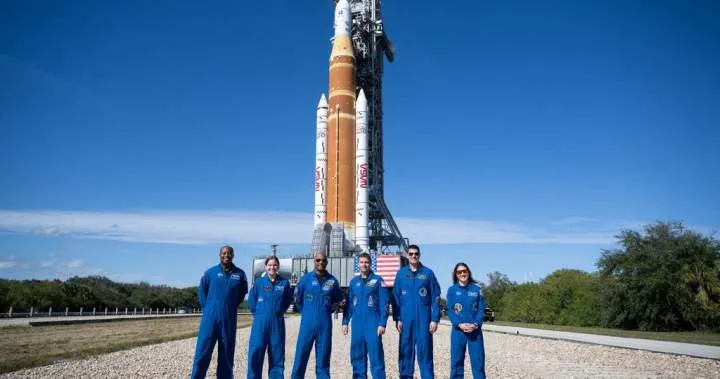
The crew for this groundbreaking mission includes four astronauts: Jeremy Hansen, Reid Wiseman, Victor Glover, and Christina Koch. Notably, Jeremy Hansen will become the first Canadian astronaut to participate in a lunar mission, highlighting the collaborative efforts between NASA and the Canadian Space Agency.
As the Artemis program progresses, it aims to create a sustainable human presence on the moon, paving the way for future exploration of Mars. The Artemis II mission will take astronauts farther from Earth than any human has been before, marking a significant leap in space exploration.
NASA’s plans extend beyond Artemis II, with Artemis III set to test new EVA suits for lunar surface operations. Furthermore, Artemis IV and V are planned for 2028, which will include landing missions on the moon.
Elkin Norena, a NASA official, remarked, “This is a historic mission in the sense that not only are there going to be people on board going toward the moon, but they’re going to go up the farthest they’ve ever gone in over 50 years.” This sentiment is echoed by Jeff Spaulding, who stated, “People are excited, and ready to go on this first chapter on our way back to the moon since the 1970s.”
Canadian astronaut Kutryk emphasized the importance of this mission for young Canadians, saying, “If you’re a young Canadian, you should be growing up into a world where nothing is impossible.” He further added, “We’re trying to go there, build infrastructure, build bases, build laboratories and be able to sustain human life to make innovations and discoveries moving forward.”
As the launch date approaches, anticipation continues to build around the Artemis II mission, which promises to reignite interest in lunar exploration and inspire future generations of astronauts and scientists.