Introduction to Solar Eclipses
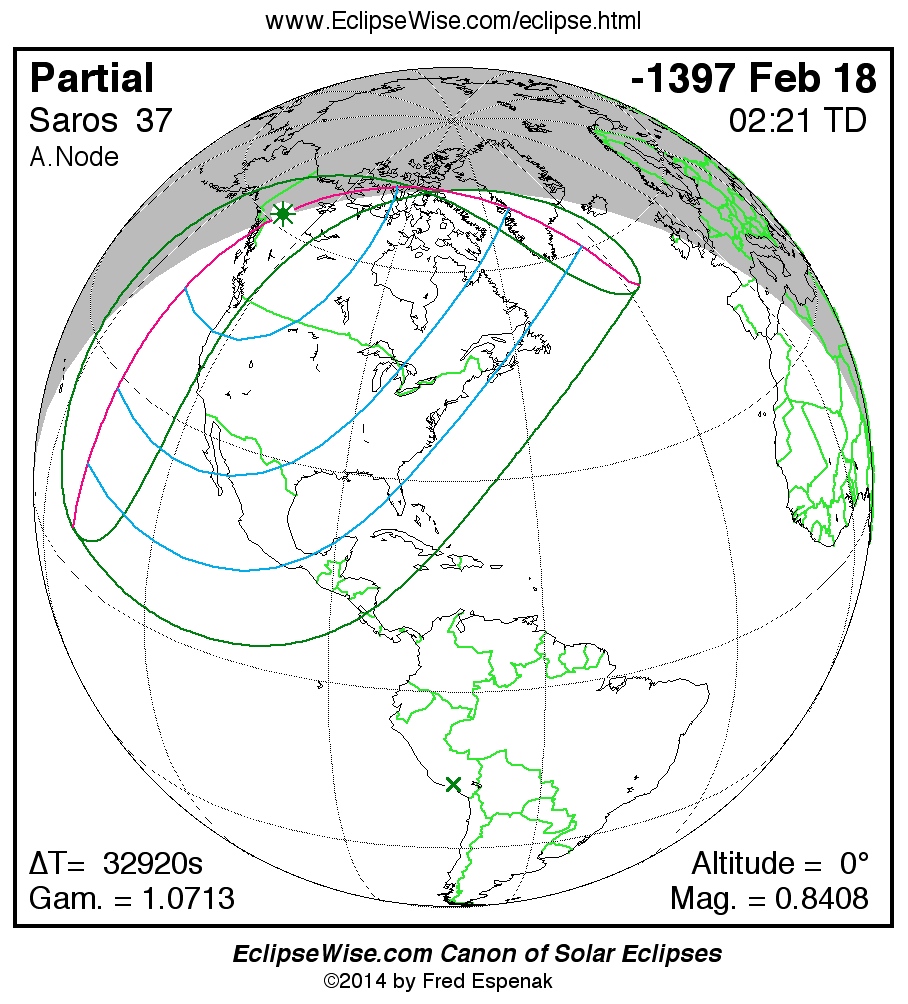
Solar eclipses are significant astronomical events that occur when the moon passes between the Earth and the Sun, obstructing the view of the Sun from a particular area on Earth. These occurrences not only captivate millions but also prompt scientific interest and public fascination due to their rarity and stunning visual effects.
Types of Solar Eclipses
There are three primary types of solar eclipses: total, partial, and annular. A total solar eclipse occurs when the moon completely covers the Sun, casting a shadow on Earth. This type of eclipse can only be observed from a narrow path, known as the path of totality. A partial solar eclipse happens when only a part of the Sun is obscured by the moon, visible from a broader area. Meanwhile, an annular eclipse occurs when the moon is too far from Earth to completely cover the Sun, resulting in a ‘ring of fire’ effect.
Recent and Upcoming Eclipses
The significance of solar eclipses is underscored by the recent total solar eclipse that occurred on April 20, 2023, which was visible across parts of Indonesia and Australia. Another anticipated solar eclipse is slated for October 14, 2023, known as the annular solar eclipse, which will be visible to millions across the Americas.
Scientific Importance and Cultural Impact
Solar eclipses have played a vital role in enhancing our understanding of celestial mechanics and the solar system. Historically, they have prompted advances in science, including the prediction of the Sun’s corona and the study of gravitational effects on light. Additionally, eclipses have significant cultural implications, influencing folklore and beliefs in various cultures throughout history.
Conclusion
Solar eclipses continue to fascinate both amateur astronomers and researchers alike. As anticipation builds for upcoming events, public education on safe viewing practices, such as using eclipse glasses, is paramount. In essence, solar eclipses not only provide breathtaking experiences but also serve as opportunities for scientific learning and cultural reflection, fostering a greater appreciation for our universe.